1. Black Holes

Black holes, spacial body with the greatest gravitational force known to mankind. Basically, black hole is a region with so much gravitational force that even light (unable to reflect) gets trapped in it. According to the scientists, black holes has such strong gravity because large amounts of matter has been squeezed in one place. Since light can't reflect against a black hole, it is impossible to see or take a picture of black hole. Scientists believe that when a star dies, all its mass gets squeezed in one place to form a black hole which, according to the "Theory of General Relativity" is able to bend the space time. Due to the high gravitational force, black holes engulfs it's surroundings thus in spite being invisible, scientists figure out the presence of a black hole by looking at the surroundings where huge amount of light (formed by the pulling of matter into the black hole) is formed in a swirling way.
2. Wormholes
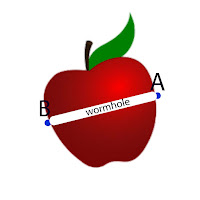

Wormholes, as layman's term is a shortcut in space-time continuum. Unlike black holes, the any existing wormholes aren't found yet. In spite of not being found its existence has been proved by "The Theory of General Relativity". As per the theory, a wormhole is like travelling through a shortcut in space-time. Albert Einstein believed that through wormholes, one can jump in different times or could time travel. A Wormhole can be easily understood with the help of an apple. Think of an apple as the space/cosmos, now if you move form point A to point B through the surface of the apple, it will take some time but if you move from point A to B through wormhole(as shown in the picture) it will take considerably less time. Same thing happens with the space.
3. White Holes

White holes, just like wormholes, a real white hole hasn't been found yet. Existence of a white hole is hypothetical. As per the general relativity, a white hole is a celestial body which releases light and matter. It is completely opposite to the black holes. As white holes constantly releases matter, it is impossible to enter into a white hole. Scientist also believe that white hole and black hole both are different sides of the same coin as one sucks matter and light, the other releases those matters and light. Although there hasn't been any evidence which prove the existence of white hole, 2006 GRB 060614 is believed to be the first sighting of a white hole.

Black holes, spacial body with the greatest gravitational force known to mankind. Basically, black hole is a region with so much gravitational force that even light (unable to reflect) gets trapped in it. According to the scientists, black holes has such strong gravity because large amounts of matter has been squeezed in one place. Since light can't reflect against a black hole, it is impossible to see or take a picture of black hole. Scientists believe that when a star dies, all its mass gets squeezed in one place to form a black hole which, according to the "Theory of General Relativity" is able to bend the space time. Due to the high gravitational force, black holes engulfs it's surroundings thus in spite being invisible, scientists figure out the presence of a black hole by looking at the surroundings where huge amount of light (formed by the pulling of matter into the black hole) is formed in a swirling way.
2. Wormholes


Wormholes, as layman's term is a shortcut in space-time continuum. Unlike black holes, the any existing wormholes aren't found yet. In spite of not being found its existence has been proved by "The Theory of General Relativity". As per the theory, a wormhole is like travelling through a shortcut in space-time. Albert Einstein believed that through wormholes, one can jump in different times or could time travel. A Wormhole can be easily understood with the help of an apple. Think of an apple as the space/cosmos, now if you move form point A to point B through the surface of the apple, it will take some time but if you move from point A to B through wormhole(as shown in the picture) it will take considerably less time. Same thing happens with the space.
3. White Holes

White holes, just like wormholes, a real white hole hasn't been found yet. Existence of a white hole is hypothetical. As per the general relativity, a white hole is a celestial body which releases light and matter. It is completely opposite to the black holes. As white holes constantly releases matter, it is impossible to enter into a white hole. Scientist also believe that white hole and black hole both are different sides of the same coin as one sucks matter and light, the other releases those matters and light. Although there hasn't been any evidence which prove the existence of white hole, 2006 GRB 060614 is believed to be the first sighting of a white hole.

Comments
Post a Comment